By Alex Reign / Updated September 2026
Quick Answer
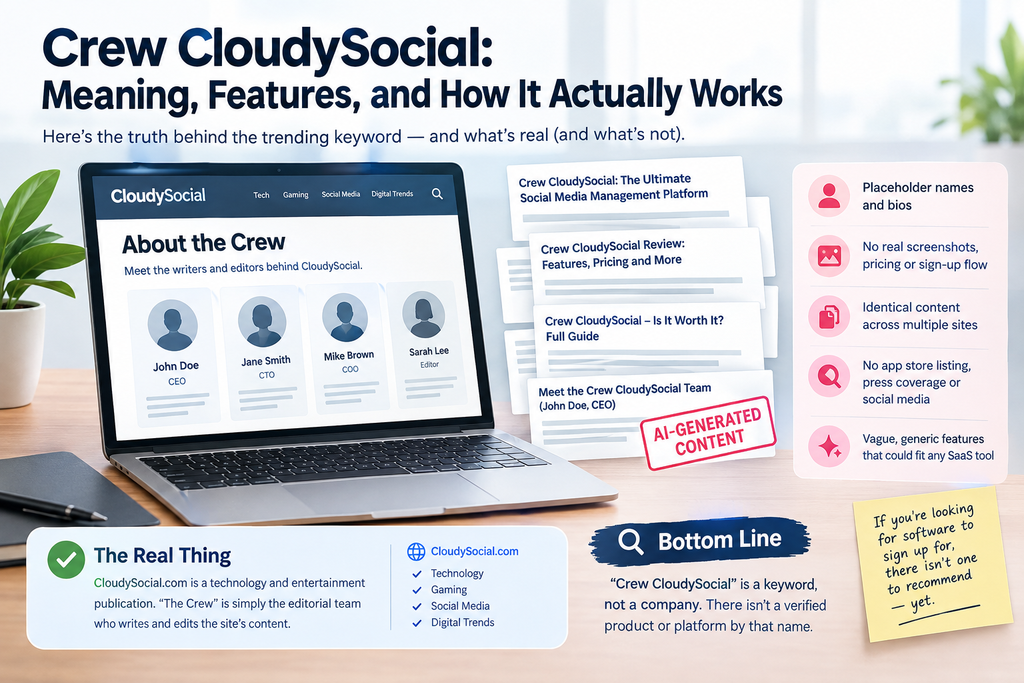
“Crew CloudySocial” is not a verified software product. There is no independently confirmed company, app, or platform operating under that name. The phrase has spread because dozens of low-quality, templated articles describe it as a “social media management platform” — using generic, copy-pasted feature lists and, in several cases, fabricated leadership teams (placeholder names like “John Doe, CEO” that were never replaced with real people). If you’re searching for this term, you’re most likely encountering a wave of AI-generated content, not a real tool. The one confirmed real thing in this whole cluster is CloudySocial.com, a technology and entertainment publication with an actual editorial “Crew” — the writers and editors who run the site.
Why “Crew CloudySocial” Suddenly Started Trending
If you searched this term recently, you weren’t imagining the flood of results. In the space of about a week, dozens of near-identical articles appeared across unrelated websites, all describing “Crew CloudySocial” as some kind of team collaboration or social media management platform. That’s unusual — legitimate software launches don’t typically generate this pattern. Coordinated, templated content spreading across low-authority sites almost always points to one thing: a keyword being farmed for search traffic, not a real product being covered by journalists.
We went looking for the actual evidence. Here’s what we found — and didn’t find.
What We Actually Checked
A real, identifiable company. None of the articles describing “Crew CloudySocial” as a platform link to an app store listing, a funding announcement, a domain registration record, or a press release. Several list a “leadership team” — a CEO, CTO, and COO — but the names attached to these roles are stock placeholder names that appear verbatim across multiple unrelated sites. That’s not a coincidence; it’s a sign the content was generated from a template and never fact-checked or customized.
A working product to test. Articles describe scheduling tools, analytics dashboards, and messaging features in vague, interchangeable language — the kind of description that could apply to literally any SaaS tool. None of them include real screenshots, a pricing page, sign-up flow, or a support email that resolves anywhere. That’s a strong tell that no one writing these pieces has actually used the thing they’re describing.
Independent confirmation. No tech press, no app directories (Capterra, G2, Product Hunt), and no social media presence turned up an actual “Crew CloudySocial” company. The only tools with a similar name are unrelated products — for example, a crew scheduling app used in retail and hospitality that has nothing to do with “CloudySocial” branding.
Taken together, this points to a keyword that got picked up by AI content generation pipelines, which then confidently invented a product description because “Crew” and “CloudySocial” sound like they should belong to some kind of software. Once one site published that guess, others scraped, reworded, and republished it — and the guess started looking like established fact simply through repetition.
So Where Does the Name Actually Come From?
The one verifiable thing behind this keyword is CloudySocial.com, a publication covering technology, gaming, social media, and digital trends. Its site includes an “About the Crew” page introducing the writers and editors who produce its content. In other words:
- CloudySocial = the publication
- The Crew = the people who write and edit it
That’s a completely ordinary, unremarkable fact — a media site naming its staff page “the Crew.” It’s very likely that this innocuous phrase got picked up out of context, misread as a product name by content-scraping tools, and then snowballed into the wave of “platform” articles you’re now seeing.
What About “CloudySocial Minison”?
This is a second keyword riding the same wave, and it shows the same warning signs: vague, interchangeable descriptions, no independently verifiable source, and content that reads as though it was generated to match the search term rather than to describe something real. Based on what’s actually traceable, “Minison” appears connected to authorship or content on the CloudySocial site rather than being a separate standalone product. Treat any article confidently describing it as software with the same skepticism.
What About Crew.CloudySocial.com Specifically?
If you arrived here because you saw the literal subdomain crew.cloudysocial.com somewhere — not just the phrase “Crew CloudySocial” — that’s a materially different situation from the generic keyword. A specific, resolvable URL is something you can check directly:
- Visit it yourself and see what actually loads.
- Check whether it has a privacy policy, terms of service, and a real “About” or “Contact” page.
- Look up the domain’s registration history.
- Search for it specifically in quotes, rather than searching the broader unquoted phrase — this filters out most of the templated “platform” articles.
Don’t take a generic “Crew CloudySocial” explainer article (including this one) as confirmation of what that specific subdomain does. Evaluate the URL on its own.
How to Spot This Pattern in the Wild
This isn’t the first keyword to get the AI-content-snowball treatment, and it won’t be the last. A few signs you’re looking at fabricated product coverage rather than real reporting:
- Placeholder names or bios that read as generic (“Jane Smith, CTO, specializes in cloud computing”) rather than a real, searchable person with a LinkedIn profile or public track record.
- No screenshots, no pricing, no sign-up flow — just descriptive paragraphs about features.
- Identical phrasing appearing across multiple unrelated domains, sometimes word-for-word.
- No press coverage, no app store listing, no social accounts you can independently verify.
- Articles that spend more time telling you the platform is “revolutionary” or “cutting-edge” than actually showing you what it does.
If two or more of these apply, treat the “product” as unconfirmed until you find a primary source.
Frequently Asked Questions
Is Crew CloudySocial a real app? There’s no independently verifiable evidence of a real company or product by this name. Most articles describing it as software rely on generic, unsourced feature lists and, in some cases, placeholder team bios that were never filled in with real people.
What does “Crew” mean on CloudySocial.com? It refers to the writers and editors behind the CloudySocial publication — the same way many media sites have a masthead or “About the Team” page.
Is CloudySocial Minison a software product? Based on available evidence, no independently confirmed standalone product exists under that name either. It appears connected to content or authorship on the CloudySocial site rather than being separate software.
What should I do if I found “crew.cloudysocial.com” as an actual URL? Treat it separately from the generic keyword. Visit the URL directly, check for a real privacy policy, contact information, and domain history before trusting any description of what it does.
Why are there so many articles describing it as a platform if it isn’t one? Search interest in an unusual phrase can trigger a wave of AI-generated “explainer” content designed to rank for that exact term, regardless of whether anything real backs it up. Once a few of these are published, others copy and reword them, and the repetition starts to look like consensus.
The Bottom Line
“Crew CloudySocial” is best understood as a keyword, not a company. The verifiable part of the story is small and unglamorous: CloudySocial.com is a real technology publication, and “the Crew” is its editorial team. Everything beyond that — the feature lists, the leadership bios, the “revolutionary platform” language — traces back to unsourced, templated content rather than anything you can independently confirm. If you came here looking for software to sign up for, there currently isn’t one to point you to. If a specific URL brought you here, evaluate that URL on its own terms rather than trusting the broader keyword cloud around it.